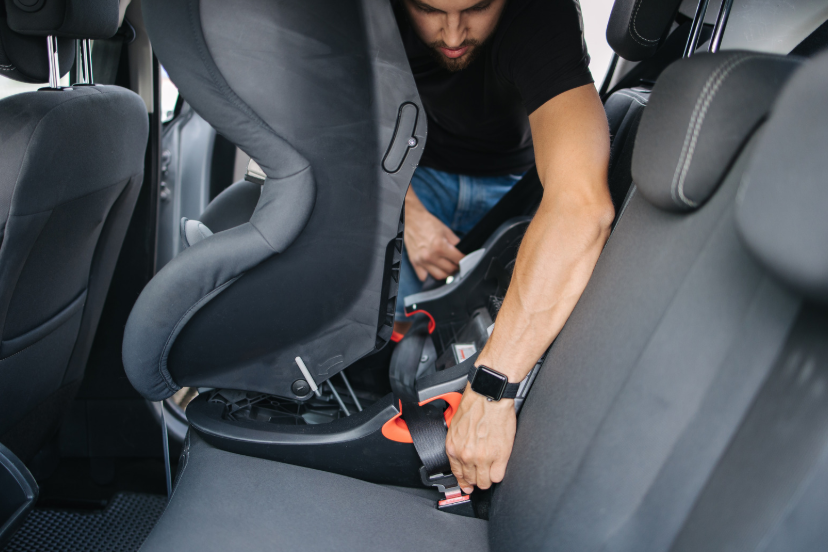
Motor vehicle crashes are the leading cause of accidental death and injuries to children across the United States. The best way to keep your child safe in a vehicle is to use the correct car seat for their age, height, and weight and to be sure it is installed correctly. A properly fitted and installed car seat can reduce the risk of death by as much as 71%.
Car Seat Installation & Education Information
If you are a parent or caregiver of a child and need assistance with car seat selection, education, or installation, please click on the green "Car Seat Assistance" button at the top of this page or contact the Department of Fire and Life Safety at 757-890-3600 (M-F between 8:15 am and 5:00 pm). We will be happy to help. Our C.A.R.E. Program is conducted by Fire and Life Safety personnel who have successfully completed the requirements for certification and who are currently nationally-certified technicians. Some people choose to drop by the nearest fire station for assistance without an appointment; however, a technician may not be available to assist you. To better serve you and ensure the location and availability of a technician, citizens are strongly encouraged to schedule appointments using the link above.
C.A.R.E. stands for Child seat Awareness and Restraint Education. This York County program is an educational program. We can check an installed car seat, answer questions, share important safety information, and assist you as you install a proper child restraint in your vehicle. Certified CPSTs are trained to TEACH YOU how to install the safety seat. If you are able, please attempt to install the seat in your vehicle before your visit. Come prepared to learn this important skill. You will receive resources to remind you of what you learned and to troubleshoot issues that may arise the next time you need to move or change a child safety seat.
*Education visits typically take 30 minutes; however, we will take the time necessary to ensure that you feel comfortable and confident in re-securing the car seat into the vehicle and re-buckling your child into the car seat on your own.
*Please note that in the event of a 911 call or emergency, the technician may not be able to honor your appointment. Your visit may be delayed or interrupted for emergency response. We will do our very best to accommodate you.
What to bring with you and to know for your scheduled visit:
- Bring your child, if possible, so the technician can check the child’s fit in the car seat.
- If your child is already born, know your child's weight and height.
- Bring the child safety seat as well as all included parts and manufacturer’s instructions.
- Bring your vehicle owner’s manual.
- If you are expecting, please try to schedule your visit several weeks prior to your baby's due date, just in case you deliver early.
- Please park in the main parking lot of the fire station scheduled. Go to the main door and ring the bell for assistance. Someone will come out to help you, unless the station is empty due to emergency response. If no one comes to help, please give us 15-20 minutes to get back after the 911 call. If we are not back by then, we apologize for the inconvenience and ask that you please call the Department of Fire and Life Safety main office number, 757-890-3600, to reschedule.
*It is extremely important to register your child’s safety seat so that you will be promptly alerted about any future recalls or safety notices. You will also receive guidance through any replacement processes. Please take the time to fill out and mail the registration card that came with your car seat. It already has your car seat’s information. You may also choose to register online using the information from the manufacturer’s sticker located on the car seat.
News to Use: (source VDH) Virginia's Child Restraint Device Law
- Virginia Law requires that all children age seven years and younger (until the eighth birthday) be properly secured in a child safety seat or booster seat.
- Safety seats must be properly used and approved to meet Department of Transportation standards. The Virginia law is based on age and proper usage. Proper selection and use of a safety seat regarding weight and height is in accordance with the instructions of the manufacturer of the safety seat. Rear-facing child restraint devices must be placed in the back seat of a vehicle. In the event the vehicle does not have a back seat, the child restraint device may be placed in the front passenger seat only if the vehicle is either not equipped with a passenger side airbag or the passenger side airbag has been turned off.
- Effective July 1, 2019: Children are to ride in a rear-facing safety seat until the age of two or the child reaches the minimum weight limit for a forward-facing safety seat as prescribed by the safety seat manufacturer. The best and safest practice is to leave a child rear facing to the maximum limits specified on the child's safety seat.
- Children can no longer ride unrestrained in the rear cargo area of vehicles.
- The law applies to anyone (i.e. parents, grandparents, babysitters, friends) who provides transportation for a child in any vehicle manufactured after January 1, 1968. Public transportation, taxicabs, regulation school buses, executive sedans, limousines, and farm vehicles are exempt. Uber and Lyft are defined by law as “Transportation Network Companies” (TNC). TNCs are not categorized as taxicabs under Virginia law and are not exempt. (Code of Virginia Section 42.2-2000. Definitions)
- The child restraint law is primary enforcement — no other violation need be committed prior to ticketing for failure to have a child in an approved seat.
- A $50 civil penalty fine is imposed for failure to have a child in a child restraint device. Any person found guilty a second or subsequent time, on different dates, will be fined up to $500. An additional $20 civil penalty fine is assessed when persons transporting a child exempted from this law due to medical reasons do not carry a written statement of the exemption. All fines collected go into a special fund to purchase safety seats for low-income families.
For more information, please visit the National Highway Traffic Safety Administration or the Virginia Department of Health.
For more information about Virginia Car Safety Laws: https://www.vdh.virginia.gov/child-passenger-safety/virginia-laws/
There are assistance programs for low-income residents who cannot afford a safety seat. Contact Virginia Department of Health, Division of Injury and Violence Prevention at 1-800-732-8333 for more information.
*Seat belts in our vehicles are designed to fit those who are at least 4’9″ tall. A seatbelt will fit correctly when the lap belt lays across the upper thighs, and the shoulder belt fits across the chest.